

SA Company News:
The Johannesburg Stock Exchange All-Share Index closed flat at the 107 109 level.
Fabricio Bloisi, CEO of Prosus, announced that Just Eat Takeaway (JET) has returned to growth in September, marking a significant turnaround after 55 consecutive months of year-on-year order declines. Management attributed the improvement to focused efforts on technology, logistics, product development, customer retention and marketing, with the company aiming to build on this momentum while improving profitability over time. The recovery follows Prosus’s R83 billion acquisition of JET, its largest investment to date. The group believes the European food delivery market remains structurally attractive and intends to apply the operational playbook that successfully drove growth and efficiency at its Brazilian business, iFood. In Brazil, iFood continues to perform strongly despite heightened competition and aggressive spending by rivals. The platform maintains around 80% of the national app-based food delivery market, with management expressing confidence in its ability to defend market share through operational excellence and scale. Beyond food delivery, Prosus reported solid performance across its broader ecosystem. OLX is delivering profitable growth, travel platform Despegar is expanding at more than 20%, and payments business PayU continues to scale profitably. Supported by these businesses, the group is prioritising investment in both JET and iFood, even at the expense of short-term profitability, as it focuses on building stronger long-term growth platforms and advancing its AI-driven technology ecosystem ambitions.
SA Economy:
The manufacturing sector weakened significantly in August, with production falling 4.3% year-on-year, reversing the 1.1% increase recorded in July. The decline highlights ongoing challenges facing the sector amid weak demand and a difficult operating environment.
The largest negative contributions came from:
Motor vehicles, parts and accessories, and other transport equipment, which declined 8.8%.
Wood and wood products, paper, publishing and printing, down 7.0%.
Petroleum, chemical products, rubber and plastic products, which fell 5.0%.
Food and beverages, down 3.0%.
Basic iron and steel, non-ferrous metals, metal products and machinery, which declined 3.0%.
On a monthly basis, manufacturing production fell 3.1%, reversing the 2.2% increase recorded in July, indicating that activity weakened considerably during the month.
The latest figures, together with the recent decline in the Absa PMI and weaker business confidence readings, suggest that the manufacturing sector remains under pressure from subdued domestic demand, cautious consumer spending and a challenging global economic backdrop. Manufacturing is therefore likely to remain a drag on economic growth in the near term unless demand and production conditions improve.
Global Economy:
US economic data continued to point to a resilient labour market, with initial jobless claims falling by
2 000 to 197 000 for the week ended 3 October, marking the lowest level since July and the fourth consecutive week that claims have remained below 200 000. The stronger-than-expected reading reinforced expectations that the US economy remains on solid footing, although continuing claims edged higher to 1.716 million, indicating some moderation in hiring conditions.
Meanwhile, Federal Reserve Governor Christopher Waller reiterated a hawkish stance on monetary policy, stating that additional interest-rate increases will likely be required to bring inflation back to the central bank’s 2% target within a reasonable timeframe. However, he noted that policymakers have flexibility regarding the timing of future hikes and are not obligated to raise rates at every meeting.
Adding to market uncertainty, Hurricane Isaias, a Category 2 storm with sustained winds of up to 100 mph, disrupted offshore oil production in the US and is forecast to make landfall along the Alabama coast or the Florida Panhandle. The storm has heightened concerns about potential energy supply disruptions at a time when global oil markets are already facing pressure from geopolitical tensions and elevated price volatility.
Global Company:
The FTSE 100 closed 0.16% lower at 10 442. Tesco climbed more than 5% after reporting a 6.3% increase in first-half adjusted operating profit to £1.78 billion, prompting the retailer to raise its full-year earnings guidance and expand its share buyback programme to £950 million. Imperial Brands also advanced 5% after announcing a £1.5 billion share repurchase programme, reflecting confidence in its cash generation and outlook. Meanwhile, Vodafone slipped 2.6% despite increasing its long-term cost-saving target for the VodafoneThree venture to £1 billion by 2032.
The Hang Seng Index is trading 1.3% higher at 24 098, as investors took advantage of recent market weakness and bought back oversold stocks. Improved sentiment was supported by stronger US futures, a recovery in broader Asian markets and a decline in oil prices after comments from US President Donald Trump eased concerns over an immediate escalation in tensions with Iran. Market gains were led by technology, financial and property stocks, with notable advances from AIA, Tencent, Xiaomi and PICC Property & Casualty, helping offset weakness in healthcare names such as Wuxi Biologics and CSPC Pharmaceutical.
In China, the Shanghai Composite is down 0.78% at 3 782.
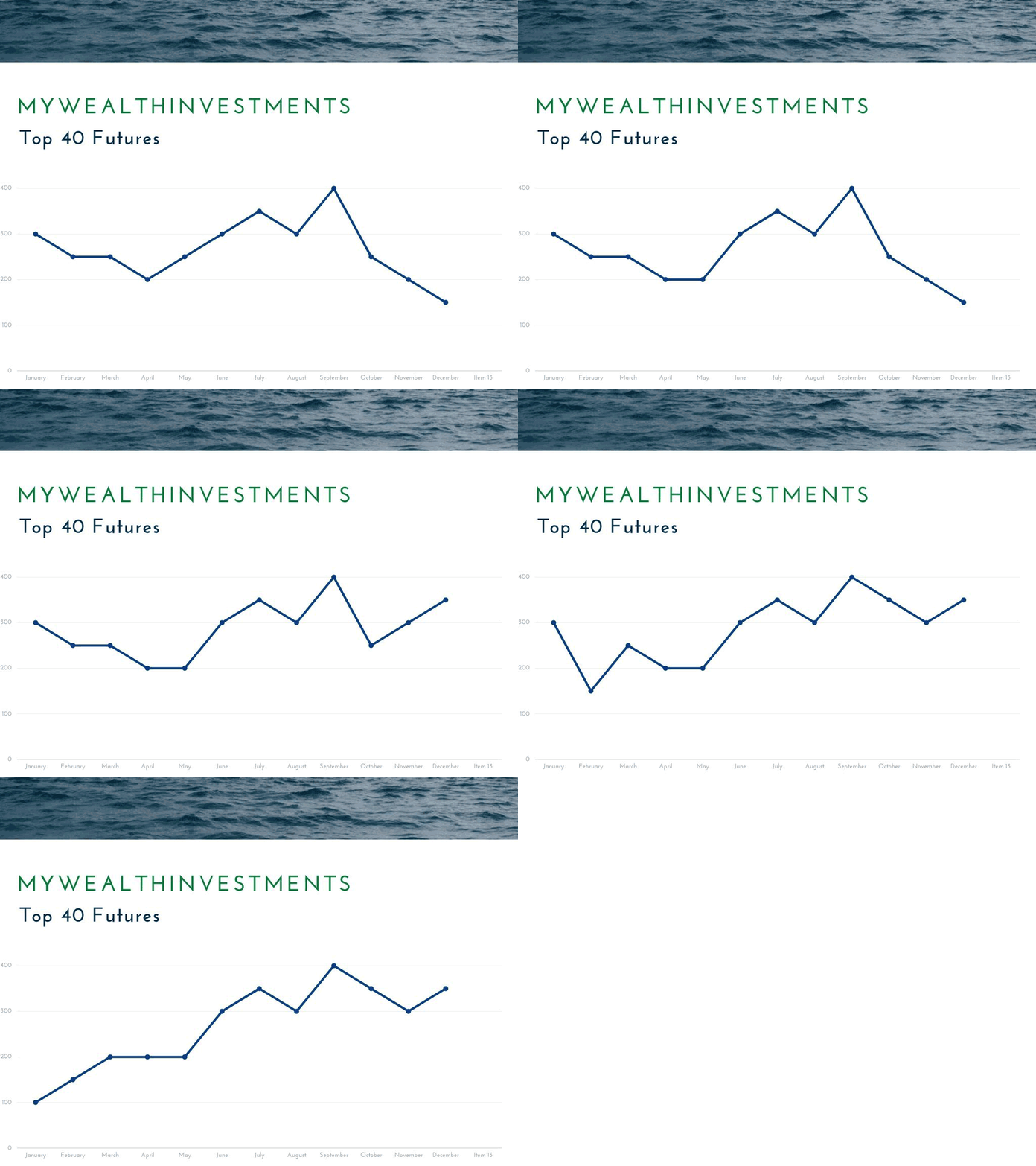
The Dow Jones Industrial Average closed 0.1% higher at 51 232, while the S&P 500 closed 0.47% lower at 7 765. US equities ended mixed as investor sentiment was pressured by a Financial Times report indicating that OpenAI’s annualised revenue was closer to $50 billion, significantly below earlier estimates of $70 billion, raising fresh concerns about the profitability of large language model developers and the sustainability of heavy AI-related investment that has been a key driver of both equity markets and US economic growth. The report triggered a broad sell-off across AI-related technology shares, particularly semiconductor producers. Nvidia fell 2.9%, Broadcom dropped 4.6% and Micron lost 4.8%, as investors reassessed growth expectations for the sector. Major cloud and technology companies also came under pressure, with Alphabet down 0.7%, Microsoft declining 1.3% and Oracle tumbling 5.8%.
Commodities:
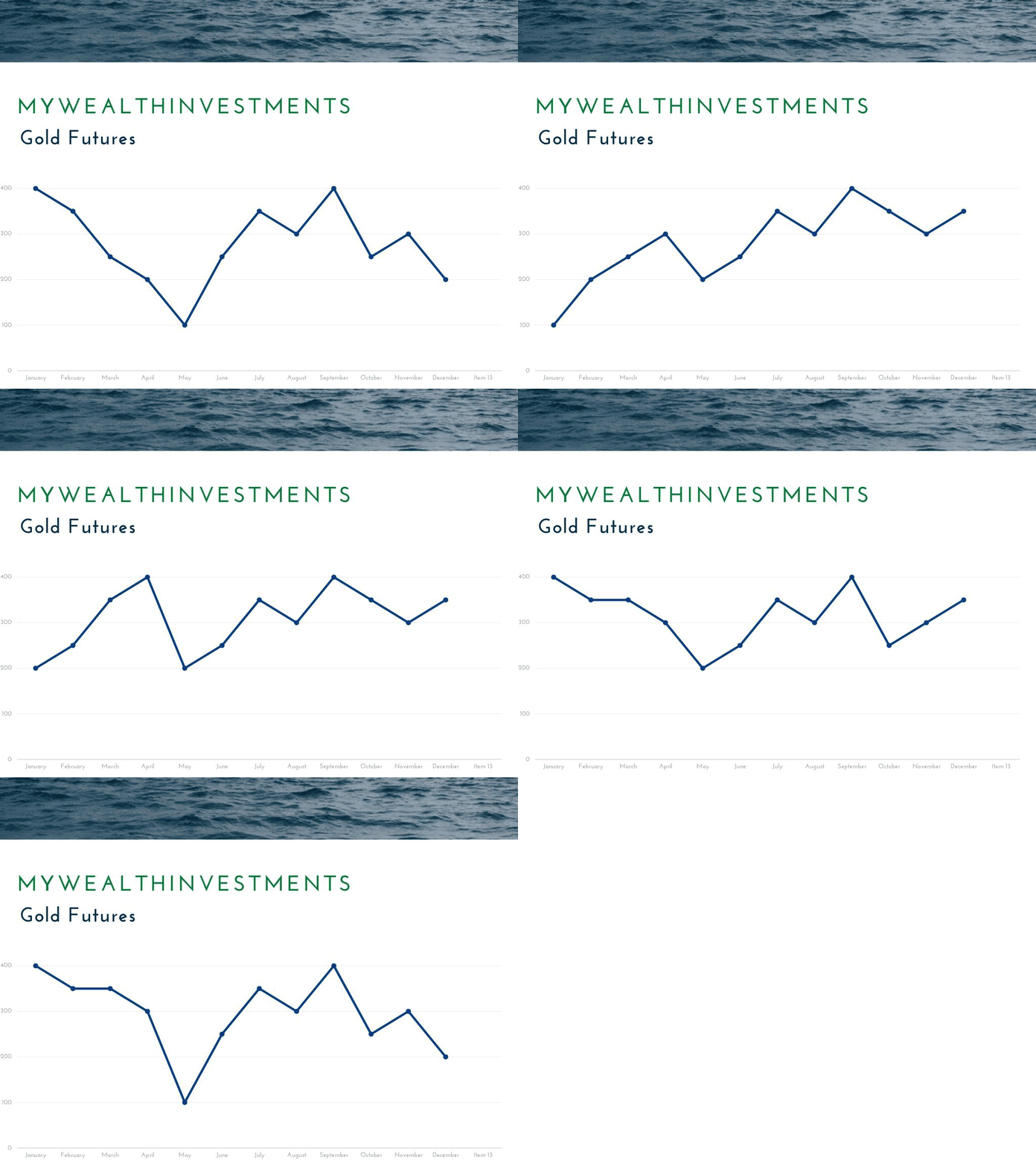
Gold is trading higher by 1.33% at $4 187/oz, while Platinum is higher by 0.75% to $1 680.20/oz.
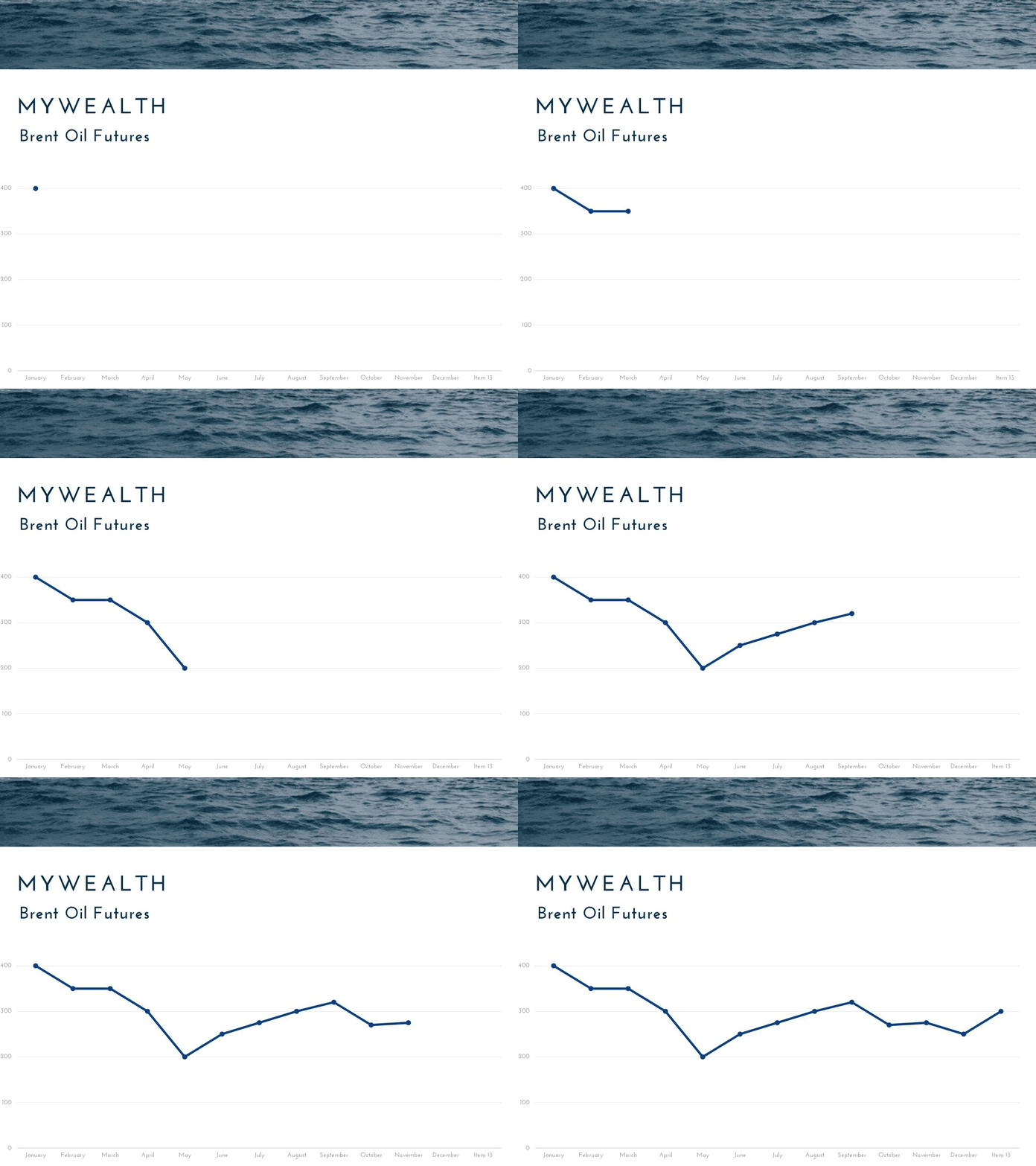
Brent crude was 0.32% higher at $102.91.
Currency:
The rand traded at R16.51 against the US Dollar, R21.87 against British Pound and R18.55 against the Euro.
The Euro is slightly firmer against the US Dollar to trade at $1.1231.
 .
.
| Market Indicators | |||||||
| Commodities $ | Cross Currencies ($) | Major Indices | |||||
| Gold | 4187.00 | 1.33% | USD/ZAR | 16.51 | Top40 | 99406.91 | 0.01% |
| Platinum | 1680.20 | 0.75% | GBP/ZAR | 21.87 | Dow 30 | 51231.64 | 0.10% |
| Brent | 102.91 | 0.32% | EUR/ZAR | 18.55 | S&P 500 | 7765.36 | -0.47% |
| Copper | 6.64 | -1.20% | EUR/USD | 1.1231 | FTSE | 10441.60 | -0.16% |
| Palladium | 1158.10 | 1.26% | USD/JPY | 158.08 | DAX | 24806.97 | -1.20% |
| Iron Ore | 90.80 | -1.10% | BITCOIN | 82336.00 | Shanghai | 3782.36 | -0.78% |
| Source: FACTSET | |||||||